
The vessel depict on this stamp, entering the Volga – Don Canal lock No 1 in 1952, is the river- passenger ship JOSEPH STALIN.
Built at the Red Sormovo plant at Gorki in 1937 for the ERM, Soviet Union. She was the lead vessel of her class, and her hull was welded
Launched as JOSEPH STALIN, four sisters
Tonnage and dimensions?
Powered by two 6-BK-43 four-stroke 6-cyl diesel engines of 350 hp. each, speed 20 km/h
The two propellers were housed particular in tunnels to protect the propeller blades.
Bunker capacity 35 ton.
Flat bottomed, did have eight bulkheads, a round stern.
She was fitted out with a steering wheel fore and aft to pass easily through the many locks in the 128 km long canal.
For heating she was fitted out with a steam boiler.
Fitted out with berths for 18 passengers and eight four person cabins used by passengers without a berth.
One cargo hold of 108 m³.
Behind the engine room there were cabins for crew, a dinning room, hairdressing saloon and an other small cargo hold of 11 m³.
Also had a cinema and concert hall and a restaurant with seats for 100 persons.
1937 The Moscow Canal was opened and for this canal this five vessels were special built to pass through this canal from Moscow to the great rivers of Russia.
In 1938 she was featured in the Russian film Volga-Volga. Some scenes of the film are showed on a envelop of Russia issued in 2003, which shows also the director of the movie Mr. G. Alexandrov.
She got the honour to open op 27 July 1952 the Volga Don canal, as seen on the stamps.
During World War II attacked by enemy bombers.
After the war in 1947 again in-service in the Moscow River.
After Stalin died, was she in 1958 renamed in MIKHAIL FRUNZE.
1971 Out of service?
A model of the ship today you can find in a hall of the Red Sormovo plant at Gorky, were you can see also the movie Volga-Volga.
Russia 1947 50k sg1273, scott. (she is one of the JOSHEP STALIN class)
Russia 1952 8k sg?, scott? (cargo vessel leaving the Volga-Don Canal)
Russia 1952 40k sg 1783, scott?
Russia1r sg1806, scott? (also a photo after which this stamp was designed)
Russia 1956 envelope for the Volga-Volga film.
Rumania 1955 1.55 lei sg?, scott? (looks a Joshep Stalin class vessel?)
Source: info and images supplied by Mr. Gennadiy Sitnikov.
17 August 1876 keel laid down.
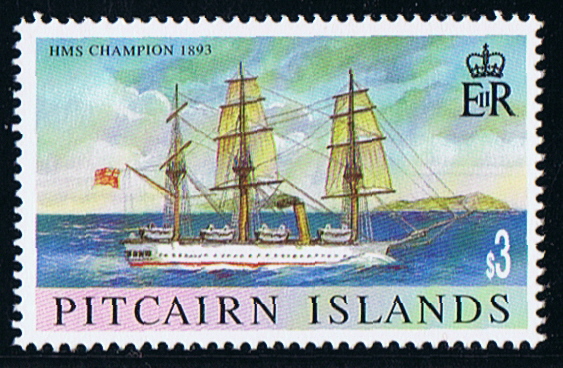
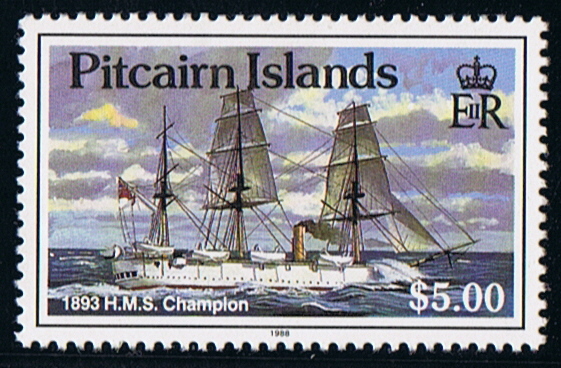
01 July 1878 launched under the name HMS CHAMPION one of the Comus class of which nine were built. She was the third vessel under this name in the Royal Navy.
Displacement: 2.380 tons, dim. 225.0 (bpp) x 44.6 x 19.3ft.
Powered by a 3-cyl. horizontal compound steam engine 2310 ihp., speed 13 knots, single shaft.
Bunker capacity 470 tons coal, range by 10 knots 3.840 miles.
Armament: 2 x 7 inc MLR, 12 x 64 pdr. guns.
Ship rigged, and fitted out with a hoisting screw.
Underwater hull was copper sheathed.
Crew 265.
07 December 1880 completed, based at Sheerness.
The intention was to use the class as scout vessel for the fleet but due to the slow speed, the class was mainly used for protection across the globe.
The class was designed by Nathaniel Barnaby.
Around 1885 rearmed with 4 – 6 inch BL MK III, 8 – 5 inch BL MK III, 4 – 3pdr. BL QF and two light guns., 6 – MG. and two TCs.
April 1886 she visited Amoy, China.
1890 Based in the Pacific.
August 1891 under command of Capt. Frederick St Clair, co-operated with some French, American and German warships by landing men at Valparaiso, Chile to protect the western consulates during a Chilean revolution.
1893 She visited Pitcairn Island under command of Capt. Rookes. He prepared a criminal code and reorganized the Governments system on the island.
26 June 1897 present at the Naval Review at Spithead in celebration of the Diamond Jubilee.
1904 Placed in harbour duty, and became a stokers training ship in Chatham,
1915 Renamed CHAMPION (old) when a new CHAMPION was built.
23 June 1919 sold to Hughes Bolckow, Blyth for scrapping.
Pitcairn Island 1988 $5 sg 326 and 1999 $3 sg 552.
Source: Conways All the World’s Fighting Ships 1860 – 1905. The Sail & Steam Navy List by Lyon & Winfield.


