
By the issues of 2013 the French Post gives: In March 2013 the Urban Community of Bordeaux, will inaugurated a new vertical lift bridge the Jacques Chaban-Delmas.
The bridge will connect two Bordeaux districts across the River Garonne; the Bacalan district on the left bank and the La Bastide district on the right bank of the river.
The bridge is designed by architect Thomas Lavigne and is a technical feat as it is one of the largest bridges in Europe, with a length of 433 metres and a height of 77 metres, her middle span can be lifted in just eleven minutes.
From Wikipedia: The Pont Jacques Chaban-Delmas is a vertical-lift bridge over the Garonne in Bordeaux, France. It was inaugurated on 16 March 2013 by President François Hollande and Alain Juppé, mayor of Bordeaux. Its main span is 110 m (361 ft) long. As of 2013, it is the longest vertical-lift bridge in Europe. It is named in honour of Jacques Chaban-Delmas, a former Prime Minister of France and a former mayor of Bordeaux.
The larger ship shown on the French stamp issued in 2013 is the BELEM built as a three-mast barque under yard No 430 by S.A. des Ancien Chantiers Dubigeon Shipyard at Nantes-Chantenay for Denis Crovan & Comp., Nantes.
10 June 1896 launched as the BELEM (Bethlehem), named after the Brazilian port Belem.
Tonnage 546 grt, dim.58 x 8.8 x 3.5m. (draught) Length bpp. 51.2m.
This type of ship was called in France an “antillais”.
30 July 1896 delivered to owners.
31July 1896 sailed on her maiden voyage from Saint-Nazaire under command of Captain Lemerle and a crew of 12 men in ballast to Montevideo before she headed to Brazil. Mostly in Brazil she loaded cocoa beans for the cocoa factory of Para at Paris.
On her twelfth outward voyage in 1902 she sailed loaded with maize to Martinique in the French West Indies, due to lack of space at Saint-Pierre she was diverted to Havre du Robert on the other side of the island.
Sunday 08 May 1902 Mount Pelée erupted, destroying Saint-Pierre and the ships in port and on the anchorage, killing at least 20,000 people including the crews of the destroyed ships.
The BELEM on the other side of the island escaped without any damage.
1906 Sold to Demange Fréres, who used her in the service between France and Cayenne.
When Féres wound up his business she was sold and came under the flag of H. Fleuriot & Co. (Société des Armateurs Coloniauxs),
Altogether she made 33 voyages across the Atlantic, but steamships took over the trade, and she was lucky that she not was scrapped.
11 February 1914 sold to the Duke of Westminster for £3,000 other source give £1,500 with the plan to convert her in a yacht. The conversion took place in the U.K. during World War I.
Her deck superstructure enlarged. The iron bulwark on the poop was replaced by a wooden banister.
Two Bollinder auxiliary engines built in each 250 hp. and fitted out with electric light.
After the war she was used as a yacht by the Duke of Westminster only for four years.
September 1921 sold to the Irish brewer Sir Ernest Guinness and renamed in FANTOME II.
Under his ownership she made an around the world cruise and visited the Arctic waters and the Mediterranean.
During World War II laid up at the Island of Wight.
When Sir Ernest Guinness died in 1949 the yacht was already for a number of years moored in Seattle, Washington, and she was inherited by his wife.
1951 She was sold to Centro Marinaro des Istituto “Scilla” of the Fondazione Giorgio Cini, and she was renamed GIORGIO CINI.
Re-rigged as a barkentine and used as a school-ship with home port Venice, Isola di S. Georgio Maggiore.
Accommodation for 60 boys between the ages of 12 – 15 years.
Between 1965 till 1965 she made training voyages in the Mediterranean.
Thereafter used as stationary school ship at San-Giorgio Maggiore, she was considered to old for sailing training voyages.
1972 Was she donated to the Italian Carabinieris who would restore her, and she was moved to Cantieri Navali e pharmacy Meccaniche di Venezia (CNOMV).
Her old Bollinder engines were replaced by two 300 hp each Fiat diesel engines.
Her rigging was restored into a barque rig, and her wooden masts were replaced by steel masts.
1976 The carabinieris were running out of cash and could not more pay the invoices of the shipyard and the ship became the property of the yard.
27 January 1979 she was sold by the yard for 4.5 million francs to the French bank Union Nationale des Caisses d’Epargnes de France. Renamed again in BELEM with homeport Nantes.
15 August 1979 she left the yard and under tow went to Toulon, afterwards towed to Brest
17 September 1979 arrived at Brest where some restoration work was carried out.
08 September 1981the BELEM was then towed upstream the River Seine and moored at the feet of the Eiffel Tower at Quai de Suffren to service as a floating attraction.
She stayed in Paris for four years in which she was visited by almost a half-million of people.
Then was she given in the hands of a shipyard in Saint-Nazaire and mostly by the work of volunteers and the cost of 18,000,000 Fr she was restored to her former glory.
Her first voyage after completing restoration was across the Atlantic after her last crossing 72 years ago for the Celebration of Centenary of the Liberty statue in New York in July 1986.
From 1987 was she used as a training ship, managed by Foundation to the Société Morbihanaise and Nantaise de Navigation, and owned by Fondation BELEM, Paris.
Homeport Nantes.
Crew five officers, 11 sailors and 48 cadets.
2013 Still in service and you can see her in many Tall Ships Races.
France 1999 1Fr sg?, scott2736f and 2013 0.58 Euro sg?, scott?
http://3mats.net/belems-history/1896-19 ... nings.html Sail Training and Cadet Ships by Underhill. De Laatste Grote Zeilschepen, Blauwe Wimpel
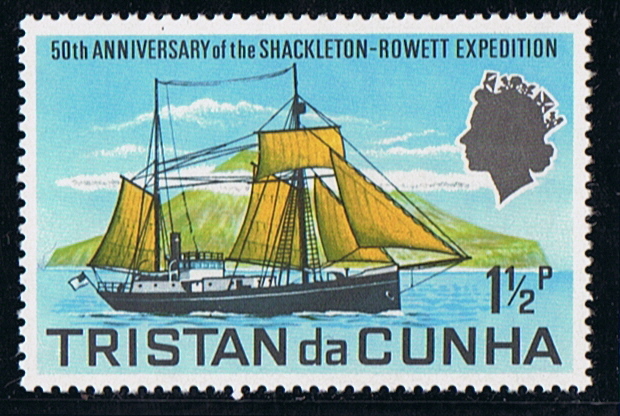
Built as a wooden hulled seal catcher by the yard of Erik Linstøls Båtbyggeri at Risor, Norway for Andr. Ingebrigtsen, Høvik near Oslo.
Launched under the name FOCA I (fishery No. K-13-K)
Tonnage 204 ton gross, 126 net, dim. 111.4 x 24.9 x 14ft. (draught)
Powered by 2-cyl. steam engines of 17nhp.
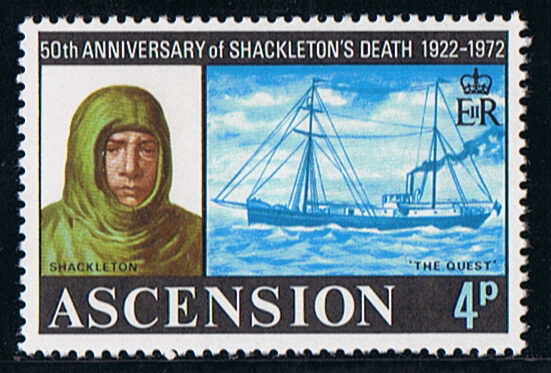
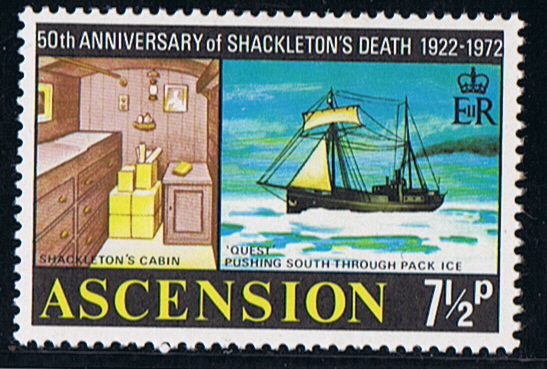
March 1921 sold to Sir Ernest Shackleton after he made a short visit to Norway, she was renamed QUEST.
Shackleton would use the vessel for his expedition to the Antarctic, but she was not so suitable for the voyage, small and straight stemmed, with an awkward square rig on her mainmast. He engines were too weak, and her boilers found at sea cracked. In all ports of call she needed repairs.
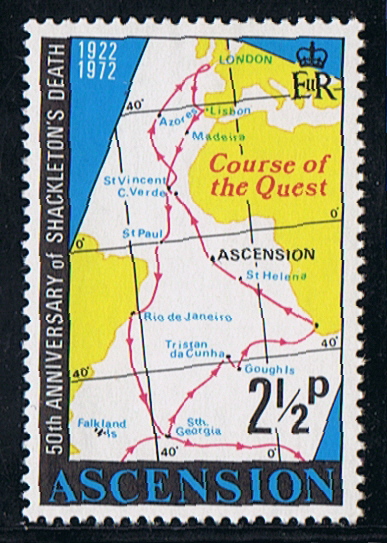
17 September 1921 she sailed from the St Katharine’s Dock in London under command of Capt. Worsley.
The QUEST made calls at Lisbon, Madeira, Cape Verde and Rio de Janeiro, at Rio de Janeiro Shackleton did have a heart attack, but when the ships doctor Macklin want to make an examination, he refused, but the doctor could see that he had a heart problem.
After sailing from Rio de Janeiro bound for South Georgia, Shackleton mentally changed he seemed unnaturally listless, always the leader and full of ideas, now he had not any plans and it seemed that he had turned to the past.
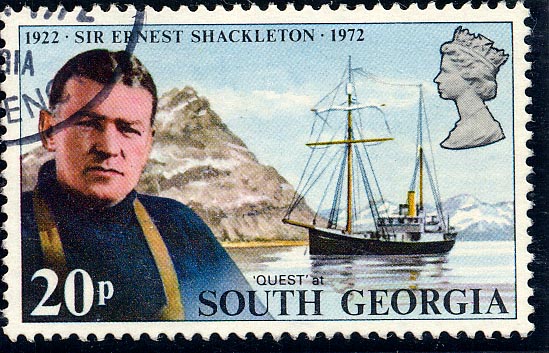
04 January 1922 she arrived off South Georgia and anchored off the whaling station of Grytviken.
Early in the morning of 5 January Dr. Macklin was called to Shackleton bunk and he found him with an other heart attack, not much he could do and a few minutes later Shackleton died.
(On this expedition Shackleton was appointed an Agent of the Post Master General for this expedition, and provided with one hundred pounds worth of British postage stamps, a circular date stamp and a trio of rectangular hand-stamps of a size to fit over a pair of stamps, for three of the countries they were expected to visit; namely Tristan da Cunha, Cough Island and Enderby Land.) as given in Log Book 1983 Vol 13 page 311.
After Shackleton death, his body was send back to England for burial, but when his wife Emily got the message of his death, she decided that her husband should be buried on South Georgia.
After arrival of Shackleton’s body at Montevideo, it was send back to South Georgia. And there his body was laid to rest on 05 March 1922 in the Norwegian cemetery.
After Shackleton died, the QUEST carried on, under Wild’s command, but he was not a leader and without Shackleton he was lost, he started drinking heavily; he had never done before on sea.
Before the QUEST sailed home in June, Wild took her to Elephant Island.
16 September 1922 she arrived in Portsmouth.
1923 Sold to to W.G Oliffe, Cowes.
March 1924 sold to Schjelderups Sælfangstrederi A/S ( Capt. Thomas Schjelderup), Skånland Bø (fishery No N-94-BN). In use as a seal catcher in the Arctic, and probably as fishing vessel in between catching seasons.
1929 Took part in the search for Amundsen and Major Gilbaud who disappeared in a hydroplane in the Arctic, while searching for General Nobile and the aircrew of the airship ITALIA.
1930/31 Deployed by H.G. Watkins in the British Air Route Expedition, the QUEST surveyed some coastal waters of Greenland
1935 Chosen to transport the Anglo-Danish expedition of Lawrence Wager and Augustine Courtauld, to Greenland, a summer expedition based at Kangerlussuag, Greenland. The QUEST returned from Kangerlussuaq on 29 August 1935, she left 7 expedition members behind who were to continue work.
1936/37 Count Gaston Micard chartered the QUEST, under command of Capt. Ludolf Schelderup, for an expedition to East Greenland; the expedition overwintered at the mouth of Loch Fyne (74N).
During the overwintering the crew of the QUEST caught 162 fox.
End July 1937 the QUEST returned to Europe making calls at Scoresbysund and Ammassalik.
January 1939 sold to Skips-A/S Quest (Ivar Austad, Tromsø) (fishery No T-24-T.
A 4-cyl 2tv Wichmann diesel engine was installed, 350 bhp.
Still used as a seal catcher, and probably in regular fishing in between seasons.
When war broke out in Norway in April 1940 she was catching seals near New Foundland, and she came under Notraship control.
Upon hearing of the German invasion in Norway she proceeded to St John’s.
November 1940 hired by the Royal Navy, as a minesweeper in the West Indies/Caribbean.
July 1941 handed back to Notraship.
March 1942 she was scheduled for convoy SC 76 from Halifax, but she did not sail.
April 1942 requisitioned by Den Konglige Norske Marine (Royal Norwegian Navy). Intended for use in Operation “Fritham 2” at Spitsbergen, Svalbard in May that year, but this was cancelled.
Then she shows up in convoy SC 83 which sails from Halifax in May 1942.
September 1942 returned to Nortraship.
21 June 1943 hired by the Royal Navy as water carrier, till 1945.
10 October 1945 laid up.
19 July 1946 returned to owner.
05 May 1962 while catching seal off the north coast of Labrador, she sprang a leak and sank due to ice.
The crew was rescued by the Norwegian seal catchers NORVARG, POLARFART, POLARSIRKEL and KVITFJELL.
Ascension 1972 4 and 4½p sg 160/1, scott 161/2
South Georgia 1972 20p sg 35, scott 34
Tristan da Cunha 1971 1½p sg 149, scott 153.
Source: Mostly copied from http://www.warsailors.com/freefleet/norfleetpq.html Shackleton by Roland Huntford. Ships of the Royal Navy Vol. II by Colledge. Log Book. Some other web-sites.


