
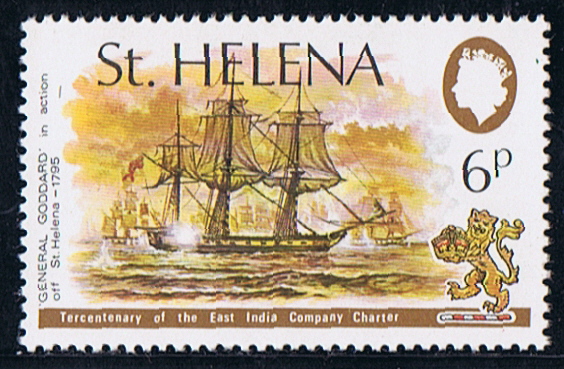
St Helena did issue a 6p stamp on 17 December 1973, which shows use the British East Indiaman GENERAL GODDARD, which captured seven Dutch East Indiamen off St Helena.
In June 1795 news reached St Helena that the Dutch Revolutionary Party had joined France in the war against England.
Captain William Taylor Money was at St Helena at that time with the GENERAL GODDARD during his fifth voyage from India.
In haste he fitted his ship out for battle, to intercept a Dutch merchant fleet known to be nearing the island.
The GENERAL GODDARD got help from the HMS SCEPTRE a 3rd Rate 64 gun ship, and the packet SWALLOW.
18 May 1795 a Dutch fleet of 16 VOC ships sailed from the Cape, escorted by two warships the SCIPIO and KOMEET bound for the Netherlands. Due to bad weather and adverse winds, eight ships returned to the Table Bay where she arrived on 20 May. One day later the eight ships sailed out again, but had lost the contact with the convoy.
14 June 1795 were these 8 ships captured by the British ships off St Helena. (Not much is given in the Dutch books I have on the VOC about this loss)
The HMS SCEPTER under command of Captain Essington arrived at St Helena in May with a convoy of homebound ships, and she brought the news that armies of France had overran the Netherlands.
Then the packet SWALLOW arrived on 2 June from the Cape with the news that an important Dutch convoy was underway from the Cape to the Netherlands.
Capt Essington made a request to the Governor of St Helena that some of the East Indiamen of the company could be put under his orders, to assist them in the search and capturing of the Dutch convoy.
The MANSHIP, GENERAL GODDARD and the SWALLOW were put under his command, and some troops from the island embarked on this vessels.
03 June this small squadron sailed out and the search for the Dutch convoy began. Five other East Indiamen were prepared to join the squadron, the ASIA, LORD HAWKESBURY, ESSEX, AIRLY CASTLE and BUSBRIDGE. All available space on the island was loaded with the goods unladed from the ships, even the church was used.
The LORD HAWKESBURY, after sailing and in an attempt to weather the island, split her sails, and returned to St Helena. The ESSEX got also in problems when her fore-top-mast sprung. The BUSBRIDGE was the only ship what made contact with the squadron.
10 June one of the ships of the Dutch fleet the HOUGLY was seized and send to the roads of St Helena accompanied by the SWALLOW, after she delivered her at the roads the SWALLOW returned to the squadron with a number of additional seamen to reinforce the squadron.
The weather was not so good; a lot of gales and the MANSHIP and BUSBRIDGE lost the contact with the squadron.
On the afternoon of 14 June, seven sails were sighted on the weather bow, steering down before the wind.
GENERAL GODDARD sailed through the Dutch convoy on about 01.00 a.m. and was fired at, without returning fire.
The next morning at day-break, the Dutch fleet was still on the starboard bow of the HMS SCEPTRE and SWALLOW, and at 07.00 a.m. she displayed Dutch colours, whilst their commodore fired a gun to leeward. This was repeated by the SCEPTRE, and Capt. Essington supposed it would be followed by
‘heaving to’ of the Dutch ships, but the Dutch ships sailed on, three shots fired by the SCEPTRE ahead of the Dutch convoy did not give the result the British hoped for.
A signal was given to the GENERAL GODDARD to chase the Dutchmen to the SCEPTRE, when the GENERAL GODDARD instantaneously appeared under a cloud of canvas and was laid alongside the Dutch commodore ship ALBLASSERDAM who from her imposing appearance thought that she was a warship, and the ALBLASSERDAM followed Money’s directions to bear down.
The Dutch crews of the other ships fired several shots to the SCEPTRE and at the boats that were sent out with boarding parties. After the SCEPTRE did give a few broadsides the Dutch surrendered. At the same time the ASIA and BUSBRIDGE arrived and all seven Dutch vessels were boarded and taken as a prize, without the loss of any person.
All the ships came to anchor in the night of 17 June on the road of St Helena.
01 July the SCEPTRE with her prizes and British convoy sailed for England, the prizes arrived at Shannon, Ireland, where she were sold. The ZEELELIE (not visible on stamp) which had attempted to escape was wrecked off the Scilly Islands that year.
A painting, which depicts this battle, was made by the British artist Thomas Luny (1759 – 1837) for Captain Money of the GENERAL GODDARD (other source gives the painting was made for Robert Wigram the owner); the painting is now in the National Maritime Museum, Greenwich.
After this painting the stamp is designed. Not the complete painting is shown but only the central portion of the painting.
The ZEELELIE and HMS SCEPTRE and the packet SWALLOW are not shown on the stamp.
The GENERAL GODDARD, in foreground of stamp, with the six remaining Dutch ships, which can be seen in the background of the stamp.
The VOC ships taken were used regular between Holland and the Far East after she were built, the URL gives a search engine for the VOC ships http://www.inghist.nl/Onderzoek/Projecten/DAS/search for more information on the voyages.
The SURCHEANCE is not given, so most probably she was never used from Holland, or a hired vessel.
ALBLASSERDAM: Named after a town in the Netherlands. Built in 1782 on the yard of the VOC at Zeeland for the Chamber of the VOC at Amsterdam.
1150 ton.
She sailed from Ceylon in 1795, with a cargo on board with a total value of 457.491 Dutch Guilder, under command of Capt. Klaas Keuken, with on board 165 persons, one died during the voyage and 11 disembark at the Cape.
MENTOR: Built on the VOC yard of Zeeland in 1789 for the Chamber of the VOC in Zeeland.
Tonnage 560 ton.
Sailed from Batavia on 22 November 1794, with a cargo on board with a total value of 61.361 Dutch Guilder. She was under command of Capt. Ulke Barendsz with on board 50 persons.
(I believe this MENTOR is also depict on the British Indian Ocean Territory stamp issued in 1999 60p sg 229, not any MENTOR is mentioned in Rowan Hackman book on the “Ships of the East India Company”. The year on the stamp is the same as when the MENTOR was built)
MEERMIN: (Mermaid). Built in 1782 at the VOC yard at Amsterdam for the Chamber of the VOC at Amsterdam.
Tonnage 500 ton.
Sailed in 1795 from Batavia under command of Capt. Gerard Ewoud Overbeek with on board 40 persons.
DORDWIJK: Built in 1787 in Rotterdam for the Chamber of the VOC of Delft/Rotterdam.
Tonnage 800 ton
22 November 1794 she sailed from Batavia under command of Capt. Hendrik Willem Ketjen with on board 40 persons.
GENERAL GODDARD:
Built in 1782 by Randall, Rotherhite for William Money.
30 January 1782 launched under the name GENERAL GODDARD.
She made her first voyage under command of Captain Thomas Foxall for the British East India Company to Bombay, she made three voyages more to India, before she was sold in 1790 to Robert Wigram.
Her next voyage to Bengal was under command of Capt. Thomas Wakefield, thereafter she made a voyage under command of Captain W.T.Money, and during this voyage she assisted HMS SCEPTRE in the capture of seven Dutch East Indiamen off St Helena.
Thereafter she made one more voyage under command of Captain Thomas Graham from 1796 till 1798 to the Coromandel Coast and Bengal.
1798 After her arrival back in England, sold as a West Indiamen for the trade to the West Indies.
January 1800 taken by a Spanish 1st Rate, 80 gun and a frigate, 32 guns off Cuba, while on a passage from London to Jamaica and taken to Havana.
Then she disappears in history.
Tonnage 799 tons, dim. 116.7 x 35.11 x 14.9ft.
VROUWE AGATHA: (Lady Agatha). Built ?, she was hired by the Chamber of the VOC of Amsterdam.
Tonnage 900 ton.
22 November 1794 she sailed from Batavia under command of Capt. Herman Pieter Murk, crew ?
On board was a cargo with a total value of 115.960 Dutch Guilders.
SURCHEANCE: Bought in 1786.
Tonnage 768 ton.
Sailed 22 November 1794 from Batavia under command of Capt. Christiaan Zummack, crew ?
Cargo on board with a total value of 81.527 Dutch Guilder.
1795 The SURCHEANCE was lost on her voyage between St Helena and the U.K.
Source: Van Compagnie naar Koopvaardij by Dr. E S van Eyck van Heslinga. Log Book Volume 14 page 234. http://www.bweaver.nom.sh/brooke/brooke_ch8.html Ships of the East India Company by Rowan Hackman.