NEPTUNE SPINEL

Built as a Freedom type cargo vessel under yard No 2600 by Ishikawajima-Harima Industries, Aioi, Japan for the Greek owner Tatmas Maritimes S.A.
08 April 1977 keel laid down
20 June 1977 launched as the MILOS ISLAND.
Tonnage 8,738 grt, 5,903 nrt, 14,967 dwt, dim. 143.4 x 19.8 x 12.4m., draught 9.1m., length bpp. 134.0m.
Powered by one 14-cyl. V-type Pielstick diesel, hp?, one shaft, speed 13.5 knots.
04 April 1978 completed and delivered under the name NEPTUNE SPINEL owned by Neptune Gamma (Pte) Ltd. Orient-Neptune Line, Singapore.

1993 Sold to Laemthong International Lines (S) Pte. Ltd., Singapore and renamed LAEMTHONG PRIDE.
1996 Transferred to Laemthong International Lines, Bangkok, Thailand not renamed.
2012 Detained in Paranaguá, Brazil.
Sold to Mumbai, India for demolition, where she arrived in November 2012.
Given by http://www.equasis.org that she was broken up since 03 March 2013.

Singapore 1978 10c sg335, scott308.

Source: Navicula. Marine News. http://www.miramarshipindex.org.nz

KILINSKI

Built as a Victory ship type VC2-S-AP3 under yard No V7 by the California Shipbuilding Corp., Terminal Island, Los Angeles for the US Maritime Administration.
26 January 1944 keel laid down.
27 March 1944 launched as the MEXICO VICTORY.
Tonnage 7,612 gross, 4,564 nrt, 10,750 dwt. dim. 138.76 x 18.9 x 8.7m. (draught).
Powered by 2 Westinghouse Electric geared steam turbine 8,400 hp, one shaft speed 16.5 knots.
Crew 51, during war service 82.
19 May 1944 completed.

After delivery managed by Luckenbach SS Co. for the US Maritime Administration, was allocated to the United States Army Transport as an Army transport.
1947 Returned to the US Maritime Administration and laid up at Suisun Bay, California.
1947 Sold to the Gdynia-America Shipping Lines Ltd, Poland, renamed KILINSKI named after Jan Kilinski (1760-1890)
Mostly used in the liner service from Poland to the Far East.
1951 Transferred to Polish Ocean Line
At the end of the Indochina War and according to the Geneva Treaty, Vietnam was divided into two parts, the Vietminh took control over the northern part and the national government kept the power in the south.
In the agreement was given that the communist guerrilla units which had been active in the south have to been withdrawn from the south. About 100.000 soldiers and civilians and equipment had to be moved to the north.
Ho Chi Minh’s government was not able to organise this and asked help from the Soviet Union, the Soviets did not have any ship available and she chartered the KILINSKI which already operated in that waters.
She was chartered for four months by Sovfracht, with a possibility for prolongation.
The KILINSKI underway to Canton was after arrival and discharging of her cargo refitted in a troop transport to carry about 4000 people.
October 1954 in service as a troop transport, the French Navy were responsible to transport the soldiers from shore to the KILINSKI in the appointed zones on the coast of South Vietnam.
About between 3000 to 4000 people and there equipment were transported every trip, under the soldiers were many wounded.
The embarkation of the people in the south was carried out by the French Navy with landing craft, what was going easily, but of the 26 voyages the KILINSKI made only one cruise the troops were disembarked in Haiphong while the other disembarkations took place on the open roads in small fishing boats and the also a motor lifeboat from the KILINSKI was used.
July 1955 she finished her charter and together with a Russian ship the STAVROPOL the two ships transported 85,000 mainly troops, 3,500 pieces of different military equipment, 250 ton ammunition.

.1972 Laid up at Haiphong, Vietnam.
1973 Sold to Poul Christensen, Denmark, renamed LIN, registered at Nakskov, Denmark.
Her only voyage under the name LIN was from Haiphong to Taiwan where she arrived on 30 June 1973. She was sold to Chin Ho Faa Steel Co for breaking up.

Poland 1956 5g sg962, scott719.

Source: Log Book. http://www.miramarshipindex.org.nz info received from Mr. Gennadiy Sitnikov.

GUENDOLEN

GUENDOLEN: Built as a gunboat by G. Rennie & Co, Greenwich near London for the British Central Africa Administration in 1897.
Displacement 340 tons, dim. 136 x 24ft.
Twin screws, speed 10-12 knots.
Armament 2 - 6pdr. Hotchkiss guns forward and 1 – 3pdr. aft.

1899 Shipped out for assembly at Port Johnston.
May 1899 she made her maiden voyage on Lake Malawi with on board the Commissioner for the Protectorate on board.
Thereafter she took over the patrol duties on the lake from the ADVENTURE and PIONEER.
August 1914 she put out of action the only German gunboat on the lake the HERMANN VON WISSMANN, which was at that time beached and under repair. The news of this action reached the U.K. and was headlines in the news papers.
Till 1940 was she in government service.
1940 Transferred to the Nyasaland Railways.
1944 Scrapped at Fort Johnston when the hull was found to be unserviceable.
Various relics from the GUENDOLEN you can find in a mock-up bridge of the ship in the Lake Malawi Museum.
One of the Hotchkiss guns is mounted in front of the Vipya Memorial near the clock tower in Mangochi.

Malawi 1967 3s sg280, scott?

Source: Lake Malawi Steamers by P.A. Cole-King.

CZECH reefer vessel.

Built as a fruit carrier under yard No 477 by Götaverken at Gothenburg, Sweden for Skibs A/S Wenoka, Oslo, Norway.
30 October 1933 launched as the CALIFORNIA EXPRESS.
Tonnage 3,649 gross, 2,219 net, 3,150 dwt. Dim. 107.22 x 14.4m., length bpp. 101.9m.
Powered by two oil engines, manufactured by Gotaverken, 4,200 shp, twin screws, speed 16 knots.
Accommodation for 12 passengers.
January 1934 delivered to owners.

After delivery managed by Skibs-A/S Fruit Express Line and used in the service from the Caribbean to the U.K./France and west coast of U.S.
When World War broke out her voyages are given on this web-site http://www.warsailors.com/singleships/c ... press.html

After the war again used in the banana trade from the Caribbean to Europe.
1949 Sold to Polish British S.S. Co, Poland and renamed in CZECH.
1951 Transferred to the Polish Ocean Lines, Poland.
07 March 1953 she rescued 62 survivors from the Egyptian Navy minesweeper SOLLUM which foundered in a storm off Alexandria.
21 September 1961 collided with the Spanish ship PLUS ULTRA.
March 1965 sold for scrap and broken up in July 1965 at Gdansk.

Poland 1953 1.35Zl sg815, scott581.

Source: Register of Merchant Ships completed in 1934. The URL given above and more sites on the Internet.

STADT LUZERN paddle steamer 1873

The side paddle steamer STADT LUZERN was the first steamboat on Vierwaldstättersee (Lake Lucerne) in Switzerland.
Built on a makeshift yard of Escher Wyss AG, near Froschenburg for the Dampfschiffahrtgesellschaft des Vierwaldstättersee, later this company was renamed after one of the founders Knorrische Dampfschiff Gesellschaft.
1836 Keel laid down.
29 July 1837 launched as the STADT LUZERN.
Tonnage 115 dwt in empty condition, dim. 37.5 x 5.1 x 2.44m. draught 1.14m empty
Powered by two 1-cyl.balancier steam engines manufactured in Manchester U.K., 40 nhp, speed 9.77 km/h.
Passengers 300, crew 6.
A flush-decked ship which could carry 10 tons cargo.

20 September 1837 made her maiden voyage from Luzern to Flüelen; she made this passage in three hours.
1838 Was she fitted out with a mast and sails, and her funnel lengthened, the mast and sails were around 1849 removed while there was no need for was
1840/41 The boiler strengthened, 1849 rebuild.
1872 Refitted in a cargo vessel and her boiler renewed.
May 1881 out of service and her steam engine, boiler and paddlewheels removed, where after she was used as a towing barge.
1888 Fitted out with a new 2-cyl.compound steam engine which drove a screw.
Then used as a coal bunker boat for the steamships on the lake.
1924 Fitted out with an oil-engine.
When the coal steamers were converted in oil fired steam ships there was not any need for coal, and the STADT LUZERN was in 1963 rebuilt in bilge water collecting vessel and renamed BIEBO.
Till 2005 in use as a bilge water collecting craft.
2009 Taken out of service.
2013 Most probably still around but can not find anything on her.

Switzerland 1986 45c sg1108, scott?

Source: http://de.wikipedia.org/wiki/Stadt_Luzern_(1837). Navicula.

AKADEMIK TRYOSHNIKOV

Built as icebreaker/research vessel under yard No2440 by the Admiralty yard in St Petersburg, Russia for the Russian Federation.
30 June 2009 keel laid down.
Launched under the name AKADEMIK TRYOSHNIKOV, named after Alexey Tryoshnikov who was the President of the Geographical Society of the USSR since 1977.
Tonnage12,701 grt, 3,810 nrt, 6,634 dwt, dim. 133.53 x 23.25 x 13.50m. Length bpp. 123.24m
Powered: diesel electric by two Wärtsilä W9L38B each 6,525 kW. and 1 Wärtsilä 6L38B, 4,350 kW, two Electric motors each 7,000 kW, two shafts, speed 15 knots. In ice of a thickness of 1.1m her speed is 2 knots.
Bunker capacity 2,479 tons.
Range 15,000 mile.
Six holds total capacity 3961 cubic meter and 3 reefer holds total capacity 881 cubic meter.
Container capacity: 24 including 5 reefer containers.
11 Scientific laboratories
Accommodation for 80 people and 60 crew.
Carried two Kamov Ka-32 helicopters.
15 December 2012 completed. Homeport St Pietersburg.
Managed by the Russian Arctic and Antarctic Research Institute.

Her maiden voyage was from St Pietersburg to the Antarctic with a call at Montevideo where she was shifted from one berth to a other on 23 January 2013 she grounded, was refloated and docked to inspect her for any damage before she sailed to the Antarctic waters.
She will be back in St Pietersburg later in 2013.

2013 In service IMO No 9548536.

On a Russian envelope issued in 2013 with postmarks I can not read. (Image of the envelope with thanks to Mr. Gennadiy Sitnikov)

Source: Russian Maritime Register of Shipping. Wikipedia and http://www.miramarshipindex.org.nz

POLLACK (SSN-603)

Built as an attack submarine under yard No 534 by New York Shipbuilding at Camden, New Jersey for the USA Navy.
When she was ordered on 03 March 1959 her intended name was BARB but before launching changed.
14 April 1960 laid down.
17 March 1962 launched as the USS POLLACK (SSN-603) one of the Permit class. Christened by Mrs. John Pastore.
Displacement 3,750 tons surface, 4,310 tonsubmerged. Dim. 84.86 x 9.63 x 7.67m. (draught)
Powered by two geared General Electric steam turbines, 15,000 hp, one shaft, speed 20 knots surface, 35+ knots submerged.
Armament: 4 – 21 inch torpedo tubes for Subroc Harpoon missiles
Crew 107.
26 May 1964 commissioned under command of Commander Harvey E. Lyon.

POLLACK reported to the Commander in Chief, U.S. Atlantic Fleet for duty, and became a unit of Submarine Squadron 4, homeported in Charleston, South Carolina. After shakedown in the Caribbean Sea, she underwent a six-month evaluation as an anti-submarine warfare (ASW) weapon.
Most of 1965 was spent at sea evaluating new ASW tactics, participating in a destroyer versus submarine evaluation, and practicing an anti-shipping mission. Also during 1965 POLLACK earned the Navy Unit Commendation.
During 1966, POLLACK was evaluated in coordinated ASW operations. She spent most of 1967 at sea, making various weapons tests. On 1 March 1968, POLLACK's homeport was changed to Norfolk, Virginia, and she became a unit of Submarine Squadron 10, the first all-nuclear attack submarine squadron in the Navy. POLLACK remained with the Atlantic Fleet into 1970.
Following refueling overhaul at Charleston Naval Shipyard, POLLACK was transferred to the Pacific Fleet and SubRon-3. She made a liberty call in Roosevelt Roads, Puerto Rico and transited the Panama Canal to reach her new home port of San Diego, California, in March 1975.
In 1979 POLLACK began a refit in Mare Island Naval Shipyard in Vallejo, California. She returned to Submarine Squadron 3, Submarine tender SPERRY (AS-12), and San Diego, California, in 1982.
In 1988, POLLACK transferred to Submarine Group 5 at Mare Island Naval Shipyard.
POLLACK was decommissioned and stricken from the Naval Vessel Register on 1 March 1989 . Ex-POLLACK entered the Nuclear Powered Ship and Submarine Recycling Program in Bremerton, Washington, on 9 February 1993. Recycling was completed on 17 February 1995.
Djibouti 2013 350 Fr sg?, scott? (other two submarines are BIBER and in the margin the SHILDER)
Source: mostly from http://en.wikipedia.org/wiki/USS_Pollack_(SSN-603) Warships of the US Navy by Morrinson and Rowe.
$post_attachment_names[$j]$post_attachment_names[$j]$post_attachment_names[$j]$post_attachment_names[$j]$post_attachment_names[$j]$post_attachment_names[$j]$post_attachment_names[$j]

Costa Rica, Honduras, Guatemala and Nicarao

The full index of our ship stamp archive

Costa Rica, Honduras, Guatemala and Nicarao

Postby shipstamps » Mon Sep 08, 2008 3:55 pm


Click image to view full size

Click image to view full size

Click image to view full size

Click image to view full size
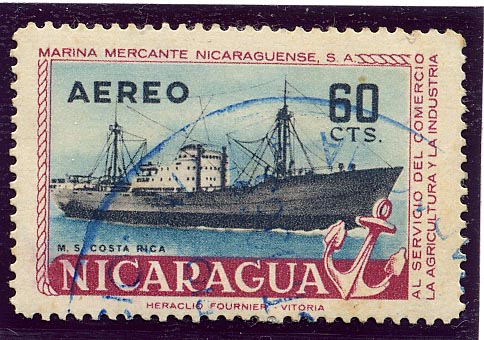
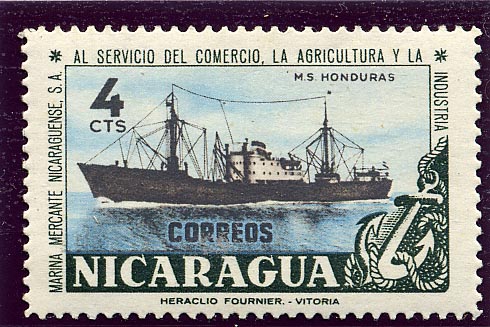
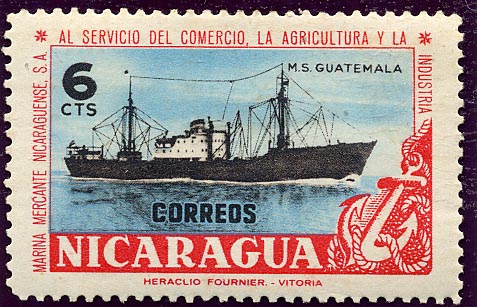
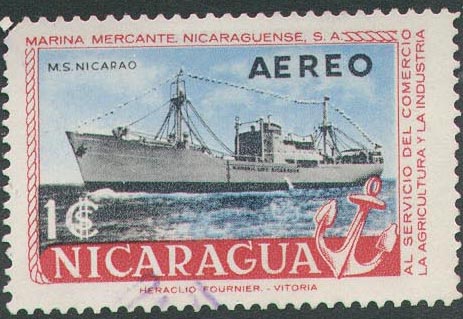
Four more motorships were ordered from Atlas-Werke A.G. of Bremen of which the Costa Rica (shown on the 60 cents stamp) was the first to be completed by the German builders. A vessel of 2,394 gross tons on dimensions 358.5ft x 47.8ft. x 20.4ft., she is driven by two 4-stroke single acting M.A.N. oil engines with pneumatic coupling and single reduction gearing to screw shaft. Horsepower is 3,800, giving the vessel a speed of 16 knots. Atlas-Werke completed the Honduras (4 cents stamp) in August 1955, the Guatemala in February 1957 (6 cents stamp) and the Nicarao latest ship of the fleet, in April 1957 (1 colon airmail stamp).
The Honduras is an identical sister to the Costa Rica, Guatemala and Nicarao. Propulsion is by M.A.N. oil engines similar to those in the Costa Rica.
The modernised Mamenic Line has its headquarters at Managua, the country's capital city, but the fleet is registered at the home port of Corento. Services are now between all Central American and the Caribbean ports, and to and from the United States and Europe, with the European office of the company at Hamburg. Besides the stamps shown, the other remaining values of the set are all of nautical interest. The Mamenic Line houseflag is shown on the 50 cents and 2.50 colon air stamps, while the 30 cents depicts a ship's wheel and a map. Two remaining stamps 15 cents and 50 cents show terrestial globes. Founder of the Mamenic Line, General A. Somoza, is portrayed on the 5 cents stamp of the set together with an unnamed ship of his fleet.
SG1309, 1300, 1302 and 1310
shipstamps
Site Admin
 
Posts: 19
Joined: Fri Mar 13, 2009 8:12 pm

Re: Costa Rica, Honduras, Guatemala and Nicarao

Postby milantodoroo » Sun Feb 17, 2013 5:36 pm

I love stamps, I'm still old-fashioned in the opinion of some people. When still sending postcards that need to buy and also stamps. In my opinion it has more value than any SMS or phone call. As much as so called old-fashioned for me will always send letters and postcards to have a longer duration. Someone may keep, one to throw, while sms will be deleted or lost in a sea of other messages, phone calls, forget it.

I appreciate your work, I often look at some stamp from your site to reminding me on a some journey.

With Kind Regards
Milan Todoroo
Lonely Holiday Maker
User avatar
milantodoroo
 
Posts: 1
Joined: Thu Feb 14, 2013 11:34 pm


Return to Ship Stamps Collection

Who is online

Users browsing this forum: Google [Bot] and 10 guests

Sponsored Links
cron