
LAS PALMAS (A-52)

Built as a tug/supply vessel under yard No 208 by Chantiers de l’Atlantico yard in Santander for Campina-Hispano-Americano de Offshore S.A., Santander, Spain.
Launched as the SOMIEDO.
Tonnage 599 grt, 791 dwt, dim. 41.2 x 11.6 x 5.08m., draught 6.10m.
Powered by two 16-cyl. AESA/Sulzer diesel engines, 7,744 hp, twin shafts, speed 13.5 knots.
1978 Completed.

1981 Sold to the Spanish Navy.
30 July 1981 commissioned and renamed LAS PALMAS (A-52).
Under navy command got a crew of 36.
Used by the navy as a rescue and maritime patrol vessel for pollution of the Spanish coastal waters.
1988 Was she converted to an Antarctic research vessel, was ice strengthened, and fitted out with a modern satellite communication system.
Fitted on deck three containers one used as a reefer store.
Accommodation for 36 crew and 20 scientists.
She was the first Spanish ship that participated in scientific missions in Antarctica.

1989 She rescued the crew of the Argentinean ARA BAHIA PARAISO (B-1) which went aground in the Bismarck Strait, Antarctic on 28 January 1989.
1999 Underwent modification work to comply with the environmental protection as given in the Antarctic Treaty.
27 November 2006 the Russian passengership LYOBOV ORLOVA ran aground on Deception Island, she was towed off by the LAS PALMAS, after which the LYOBOV ORLOVO under her own steam proceeded to Ushuaia.
Every year during the Southern summer she proceeds to the Antarctic waters for the transport of scientific and technical personnel from Argentina and Chile to the two Spanish Antarctic bases.
2013 In service.

Spain 1991 55p sg3139, scott2666.

Source: Marine News. Log Book. Watercraft Philately

CHAKRI NARUEBET HTMS

Built as a V/STOL carrier by Bazan, El Ferrol, Spain for the Royal Thais Navy.
27 March 1992 ordered.
12 July 1994 laid down.
20 January 1996 launched as the HTMS CHAKRI NARUEBET, named in honour of the Chakri Dynasty.
Displacement 10,000 ton standard, 11,486 tons full load. Dim. 182.65 x 22.5 x 6.12m. (draught) Length bpp. 164.1m.
Powered by two GE LM2500 gas turbines, 44,240 shp. and two Bazan-MTU 16V1163 TB83 diesel engines 11,780 shp, twin shafts, speed 25.5 knots.
Range by a speed of 12 knots, 10,000 mile.
Armament: 2 – 0.5 inch MG, 3 – sextuple Sadral launchers for Mistral surface-to-air missiles.
Aircraft carried when built 6 AV-8S Matadors, 4 -6-70B Seahawk helicopters and up to 14 additional helicopters when required.
Crew 457, 146 aircrew and up to 675 soldiers.
27 March 1997 commissioned.

HTMS CHAKRI NARUEBET, meaning "In honour of the Chakri Dynasty") is the flagship of the Royal Thai Navy (RTN), and Thailand's first and only aircraft carrier. Based on the Spanish Navy’s PRINCIPE DE ASTURIAS design and constructed by Spanish shipbuilder Bazán, CHAKRI NARUEBET was ordered in 1992, launched in 1996, and commissioned into the RTN in 1997.
The aircraft carrier is designed to operate an air group of V/STOL fighter aircraft and helicopters, and is fitted with a ski-jump. Initial intentions were to operate a mixed air group of Matador V/STOL aircraft and S-70B Seahawk helicopters. However, by 1999, only one Matador was operational, and the entire V/STOL fleet was removed from service in 2006. Although CHAKRI NARUEBET was intended for patrols and force projection in Thai waters, a lack of funding brought on by the 1997 Asian Financial Crisis means that the carrier has spent much of her career docked at the Sattahip naval base.
CHAKRI NARUEBET has been deployed on several disaster relief operations, including in the aftermath of the 2004 Indian Ocean earthquake and tsunami, and in response to separate flooding incidents in late 2010 and early 2011. Outside of disaster relief, the carrier's few other departures from port are for a single training day per month, and transportation of the Royal Family of Thailand, leading to claims by some naval commentators that the ship is merely an oversized royal yacht.
When Typhoon Gay hit Thailand in 1989, the Royal Thai Navy, as the main unit responsible for search and rescue missions, found that its ships and aircraft were unable to withstand the rough weather at sea. Moreover, the Royal Thai Navy needed a new, high-technology ship to modernize its fleet. The original plan was to acquire a 7,800 ton vessel from Bremer Vulcan, but the Thai government cancelled the contract on 22 July 1991. A new contract for a larger warship to be constructed at Bazán's shipyard in Ferrol, Spain, and was signed by the Thai and Spanish governments on 27 March 1992.The proposed vessel was based on the design of the Spanish Navy aircraft carrier PRINCIPE DE ASTURIAS, which in turn was based on the United States Navy's Sea Control Ship concept. Some defence industry websites refer to the ship as an "Offshore Patrol Helicopter Carrier".
CHAKRI NARUEBET is the smallest aircraft carrier in operation in the world.
CHAKRI NARUEBET is fitted with two 0.5-inch machine guns, and three Matra Sadral sextuple surface-to-air missile launchers firing Mistral missiles. The missile launchers were installed in 2001. The vessel is also fitted for but not with an 8-cell Mark 41 Vertical launch system for Sea Sparrow missiles, and four Phalanx close-in weapon systems.
The carrier was designed to operate an air group of up to six AV-8S Matador V/STOL aircraft, plus four to six S-70B Seahawk helicopters. CHAKRI NARUEBET is also capable of carrying up to fourteen additional helicopters; a mix of Sikorsky Sea King, Sikorsky S-76, and CH-47 Chinook. There is only enough hangar space for ten aircraft.
The Matador is a first generation export version of the Hawker Siddeley Harrier, acquired secondhand from the Spanish Navy in 1997. The nine Spanish aircraft (seven standard version plus two TAV-8S trainer aircraft) were refurbished by Construcciones Aeronáuticas SA firm before delivery. By 1999, only one aircraft was operational, and the RTN was looking for other first-generation Harriers to cannibalize for spares. In 2003, the navy attempted to acquire several second-generation, ex-Royal Navy Sea Harriers FA2 aircraft from British Aerospace, but the deal did not go ahead. The inoperative Matadors were finally eliminated from service lists in 2006. Thailand was the last remaining government using first generation Harrier airframes.
The flight deck measures 174.6 by 27.5 meters (573 by 90 ft). A 12° ski-jump assists V/STOL aircraft to take off. There are two aircraft lifts, each capable of lifting 20 tons.
She arrived in Thai waters at the start of August 1997, and formally entered service on 10 August.
CHAKR NARUEBET cost US$336 million to build.
CHAKRI NARUEBET is the first aircraft carrier to be operated by a Southeast Asian nation She is assigned to the Third Naval Area Command, and her intended duties include operational support of the RTN's amphibious warfare forces, patrols and force projection around Thailand's coastline and economic exclusion zone, disaster relief and humanitarian missions, and search-and-rescue operations. However, at the time the carrier entered service, the 1997 Asian Financial Crisis prevented the necessary funding to operate the ship from being available. Consequently, CHAKRI NARUEBET is usually only operational for a single day per month for training, with the rest of the time spent alongside as a "part-time tourist attraction”. The ship rarely leaves the proximity of the Sattahip naval base, and when she does, it is usually to transport and host the Royal Family of Thailand. Naval commentators consider CHAKRI NARUEBET to be less an aircraft carrier and more the world's most expensive royal yacht, while the Thai media have nicknamed the ship "Thai-tanic", and consider her to be a white elephant.
Between 4 and 7 November 1997, CHAKRI NARUEBET participated in disaster relief operations following the passage of Tropical Storm Linda across the Gulf of Thailand and the Kra Isthmus. The carrier's main task was to search for and assist any fishing vessels affected by the storm.
Flooding in the Songkhla Province resulted in the carrier's mobilization in late November 2000. CHAKRI NARUEBET was anchored at an island marina off Songkhla, and used as a base for helicopters and small boats transporting food, supplies, and wounded.
In January 2003, anti-Thai riots were sparked in Phnom Penh by incorrect news reports of a claim by a Thai actress that the Angkor Wat temple complex belonged to Thailand, not Cambodia. CHAKRI NARUEBET was sent to help with any evacuation of Thai citizens from Cambodia.
Following an undersea earthquake in the Indian Ocean, tsunamis struck multiple regions around the Indian Ocean, including the Andaman Sea coast of Thailand. The personnel of CHAKRI NARUEBET were part of a 760-strong response by the Thai military to the disaster. This task force was involved in search-and-rescue around Phuket and the Phi Phi Islands, treatment of wounded and handling of dead, and repair work to schools and government facilities.
During the August 2005 filming of Rescue Dawn, a dramatized biographical film of US Navy pilot Dieter Dengler and his capture during the Vietnam War, the flight deck of CHAKRI NARUEBET was used to represent the carrier USS RANGER.
In November 2010, the ship was involved in flood relief operations following the 2010 Thai floods; anchored off Songkhla Province, relief supplies and food were airlifted to people in the region, while hospital patients were evacuated by the ship's helicopters. CHAKRI NARUEBET was...

Oruwa. Sri Lanka

Term frequently describes a very narrow single-outrigger canoe of western and southern Sri Lanka that engages in several types of fishing, going as far as 40km from shore. Dugout base to which a vertical or tumble home washstrake, ca. 38cm deep, is sewn to each side; replaced by fiberglass hulls. Washstrake extends beyond the dugout and continues the raking line of the ends for ca. 61cm; closed at the ends; bow slightly fuller than the stern; gunwales beaded with shells. Since the opening at the top is only 27-38cm wide, the paddlers may sit on a bamboo platform outboard with just one leg inside the boat. Strengthened by stout battens toward the ends and by rods that serve as thwarts and as tacks for the sail. Two down-curving, flexible booms connect directly with the cigar-shaped float, which is about half the length of the boat; one boom set toward the bow, the other roughly amidships and on the outer end, a raised piece serves as a foothold for 1-2 men who may ride the boom as ballast. Also has 2-3 leeboards. Waterproofed with a black gum; protective coating of coconut oil applied weekly. Steered by foot with a heavy oar that may pass through a hole in the gunwale. Sets a square sail to a single mast stepped amidships or a rectangular sail supported at the top corners by 2 light masts; one forward of the sail, the other aft; one mast fitted into a thick ring of coir while the other steps into a wooden shoe. The outrigger remains on the same side and the V-mast is twisted around, the backstay shifted, and the sail moved to the other side of the mast when sailing in the opposite direction. Sails usually tanned. Rowed when wind fails. Crew of 4-8. Reported lengths 4.6-5.9m
Benin 1999;135f;SG?
Source : A Dictionary of the world’s Watercraft from Aak to Zumbra.

Local afloat rafts of Iraq

Iraq issued a stamp with a picture of the ancient afloat rafts. Quffa.Iraq. In front of stamp image round basket boat,other name “quffa”.This boat still seen occasionally on upper parts of the Tigris and Euphrates. The craft has had at least a 2,500-year history. An all-purpose boat for carrying produce, merchandise,minerals, passengers, and livestock, and for use ferryboat, lighter, or tender. Formed by concentric of interwoven layers of straw and palm fronds bound with palm-fiber rope; strengthened by curved, closely spaced ribs of split withes sewn to the walls. Large boats coated with hot bitumen outside and on the inside to level the floor; to ward off the "evil eye," cowrie shells and blue beads may be pressed in before the bitumen hardens; small boats not coated. Originally leather-covered. Bottom nearly flat; tumble home to sides; stout, cylindrical gunwale; short, wooden bars spaced along the inside on which the paddler may kneel. Paddled in deep water, stroking to left and right; poled in shallow water; going downstream, straw bumpers may be placed at the "bow," and a stone may be dragged behind to keep its head-ing. Crew of 1-2. The large class (the hessan) is 4.9-5.5m in diameter and has a capacity of 12-16t; the medium size ranges between 2.1-4.6m in diameter; the smallest (the qishir), used mainly for fishing, is 0.91-1.8m in diameter and 0.76m deep.
Chalabiya.Iraq.S. In middle of stamp image reed canoe,other name-“chalabiya”.This boat of the Marsh Arabs. Con¬structed of long bundles lashed separately and then together to form the flattened bottom. Sides created by reeds bent U-shaped, reinforced by willow wands. Upper half of the sides "planked up" inside with long bundles. Ends sharp; several stout thwarts fixed in with softened bitumen. Exterior coated with succes¬sive layers of bitumen. Last about a year. Length ca. 3.1m, beam 0.76m. Note also chalabiya.
It is cigar-shaped reed raft that is poled or paddled in the marshes of the lower Tigris River.Used mainly for hunting and fishing by 1-2 men. Reported lengths 2.44-3m; a larger type is called an 'abadije.

Kelek.Iraq
Behind of stamp image raft,other name-“kelek”.
Square or rectangular raft of inflated goat, and sometimes camel, skins. Found mainly on the Tigris River,but also on the Euphrates. In use for at least,2700 years, carrying produce, firewood, grain, pottery,wool and people. Also used in eastern Turkey,sometimes to transport military personnel and equipment. Range from 1-family rafts of 4-6 skins to larges rafts of as many as 1,600 skins that plied the Tigris between Mosul and Baghdad. Usually dismantled upon completing a trip, the poplar framework sold for lumber or firewood, and the skins deflated, retanned, and transported back upstream donkeys might be carried on board to serve as transportation home. Skins lashed to a poplar pole platform or layers of crossed branches on top of which are placed straw mats or a wooden floor. A hut may be constructed for the crew or when carrying special passengers. Skins positioned so they can be re-inflated en route by means of a reed pipe. In hot weather, the skins must be constantly splashed with water to keep them from bursting. Steered with long sweeps. Oars of split willow.Crew of 2-4. Average 3.6-4.6m long, 4.4-4,9 wide;one with 200 skins would be ca. 9m by 6m.

Iraq 2002;150dinar;SG?
Source : A Dictionary of the world’s Watercraft from Aak to Zumbra.

PHILIPPINE SEA USS

Built as an aircraft carrier under yard No 1570 by the Bethlehem Shipbuilding Corp. at Quincy for the USS Navy.
19 August 1944 laid down as the WRIGHT, but after the Battle of the Philippine Sea renamed.
05 September 1945 launched as the USS PHILIPPINE SEA, christened by Mrs. Albert B. Chandler. She was one of the Essex class.
Displacement 27,100 ton standard, dim. 270.7 x 28.3 x 8.71m. (draught), length bpp. 249.9m.
Powered by four Westinghouse geared steam turbines, 150,000 shp, four shafts, speed 30 knots.
Armament: 4 – 2, 4 – 1 – 5 inch dual purpose guns. 10 – 4 and 2 – 2 Bofors 40mm AA guns.
Carried when built 90 – 100 aircraft.
Crew 3448.
11 May 1946 commissioned. Capt. D.S. Cornwell in command.

In June the ship went to Quonset Point, R.I., for initial training of the crew. By September 1946, she began her shakedown cruise in the Caribbean area with Air Group 20 embarked.

Upon returning from shakedown exercises, PHILIPPINE SEA was ordered back to Boston to prepare for the Navy’s Antarctic Expedition, Operation Highjump. On 29 January 1947, in the Antarctic region of the South Pacific, Rear Admiral Richard E. Byrd and his party were flown from the ship to begin their polar explorations from Little America.

During the remainder of 1947, PHILIPPINE SEA operated in the Atlantic and Caribbean. In the spring of 1948, the ship was deployed to the Mediterranean to join Vice Admiral Forrest Sherman’s 6th Fleet. With Air Group 9 on board, PHILIPPINE SEA showed the American ensign in France, Greece, Tunisia and Sicily. In June 1948, the huge carrier returned to the United States.

During the summer, PHILIPPINE SEA was engaged in developing doctrine for carrier control approach landings, the sea going equivalent of GCA. November found her exploring the lower rim of the Arctic Circle in a cold weather operation designed to test planes, ships, and equipment.

In January 1949 the ship was again ordered to the Mediterranean, with Air Group 7 embarked. Returning at the end of May’ the ship went immediately into overhaul at the Boston Naval Shipyard. Early autumn found the ship once more in the Caribbean, “shaking down,” this time with Air Group 1. Operational development projects with jet fighters and task force exercises in the North Atlantic kept the ship and her air group busy until the end of the year.

Operating again from her base at Quonset Point, PHILIPPINE SEA was employed during the winter of 1950 in qualifying carrier pilots and, for part of February and most of March, took part in extensive fleet exercises in the Atlantic and Caribbean. April and May were taken up with demonstration cruises for guests of the Secretary of the Navy, the Armed Forces Industrial College, Air War College, and the Armed Forces Staff College.

On 24 May, PHILIPPINE SEA sailed from Norfolk, Va., passed through the Panama Canal, and arrived at her new homeport of San Diego, Calif., to become a welcome addition to the Pacific Fleet.

With the outbreak of war in Korea, PHILIPPINE SEA was ordered to Pearl Harbor, She sailed for Hawaiian waters on 5 July with Air Group II embarked. The ship departed for the forward area 24 July. Leaving Pearl Harbor, PHILIPPINE SEA sailed at full speed for the Western Pacific, reaching Okinawa 4 August.

PHILIPPINNE SEA sailed into action off Korea as flagship of Task Force 77 on 5 August. She launched air strikes to rain thousands of tons of bombs, rockets, and napalm down on strategic targets. As many as 140 sorties a day were launched from the carrier. Except for time out to re-arm, refuel, or repair for brief periods, PHILIPPINE SEA was in action continuously.

Operating with other carriers of Task Force 77, she hit North Korean rail and communication centers from Seoul to Wonsan in September. In the Yellow Sea she put on a major performance softening up the Inchon invasion coast. D-Day, 15 September, found PHILIPPINE SEA planes ranging far inland to destroy any attempts by the enemy to bring up reinforcements. Following the initial assault, she continued to provide close and deep support for the thrust inland to Seoul.

Two months later when the Chinese Communists surprised the United Nations ground troops with a smashing drive south, down the middle of the peninsula, PHILIPPINE SEA planes dived through snow and sleet to hold back the Red hordes. Throughout the long retreat from the Yalu, the ships’ Panther jets, Skyraider attack bombers and Corsair fighter bombers blasted the path for the trapped Marines. Hill after hill was cleared all the way to Hungnam where PHILIPPINE SEA and other carriers of Task Force 77 sent up a virtual aerial umbrella Hundreds of carrier planes swarmed over the tiny evacuation perimeter from which 150,000 troops and civilians came sea.

Putting into Yokosuka Naval Base, Japan, in late March 1951 for rest and repair, PHILIPPINE SEA exchanged Air Group 11 for Air Group 2 from Valley Forge. The same date as the transfer, 28 March, PHILIPPINE SEA became flagship of Vice Admiral H. M. Martin, Commander 7th Fleet.

From the Sea of Japan in April, PHILIPPINE SEA led Task Force 77 and other elements of the 7th Fleet down through the Strait of Formosa to the South China Sea. From the Formosa Strait, planes paraded over the island of Formosa in an attempt to bolster Nationalist morale. After this demonstration of strength, the force steamed back to Korea three days later, in time to lend close air support to the embattled ground forces. Every Chinese offensive of the spring of 1951 suffered staggering losses in personnel as planes of PHILIPPINE SEA peppered the Reds with deadly fragmentation bombs.

PHILIPPINE SEA returned from her operations in Korean waters and the western Pacific to arrive at San Francisco 9 June 1951. Yard availability and operations along the West Coast continued until the ship departed from San Diego 31 December. Arriving at Pearl Harbor 8 January 1952, PHILIPPINE SEA continued on to Yokosuka, Japan, arriving 20 January.

PHILIPPINA SEA returned to San Diego in August 1952. Her designation was changed to CVA in October. With Carrier Air Group 9 embarked, she got underway once more for the Far East early in December 1952. Air strikes from the carrier cut Communist supply and transportation arteries. The North Korean offensive, begun at the same time the first truce overtures were extended, marked the beginning of a series of “round the clock” air sorties in support of frontline UN troops.

The ship arrived in Alameda Naval Air Station 14 August 1953 to off-load Air Group 9, then entered dry-dock at Hunter’s Point for overhaul. On 9 January 1954 PHILIPPINE SEA once more began training off the coast of San Diego. She then headed west 12 March for her fourth tour in the Far East. She operated out of Manila.

The most significant event of the cruise occurred in late July. Communist planes had shot down a Cathay-Pacific Airways passenger liner somewhere near Hainan Island off the Chinese coast. PHILIPPINE SEA was ordered into the area as part of a search mission with the hope that the remaining survivors might be found. While engaged in the search mission, a flight of the ship’s Skyraider aircraft was attacked by two Communist fighter aircraft. Under orders to fire only if actually attacked, the Skyraiders returned the fire and shot down the Communist planes. Later this came to be known unofficially as the “Hainan Incident.”

The ship returned to San Diego, Calif., in November. Remaining in the area for four months, PHILIPPINE SEA conducted extensive training operations off the California coast. She began her fifth cruise of the Far East 1 April 1955 en-route Yokosuka. She operated in waters of Japan, Okinawa, and Taiwan. On 15 November she was redesignated as a...

AL-WATTYAH

Built in 1979 by Hyundai Heavy Industries Ltd. Co. Ulsan, #116, for United Arab Shipping Co. Kuwait. Container ship, Gt:20.526, Nt:7849, Dw:20.231, Loa:183,24m. Lbp:168,76m. B:27,49m. D:15,91m. Draught:10m. 7 cyl. Mitsui/B&W engine:14.600 hp. (10.739 kW.) 17 kn. TEU:1612, IMO.7802275.
09-2008 sold for scrap.
(Kuwait 1982, 30 f. StG.939)
LR97/98 + internet.

FOCH (R99)

Built as a aircraft carrier under yard No H18 by Atlantique (Penhoet-Loire) at St Nazaire for the French Navy.
1955 Ordered.
15 February 1957 keel laid down.
28 July 1959 launched as the FOCH (R99) one of the Clemenceau-class.
Displacement:24,200 ton standard, 32,500 ton full load. Dim. 265 x 51.20 x 7.50m, draught 8.6m.
Powered by four steam turbines, 126,000 hp, twin shafts, speed 32 knots.
Bunker capacity 6,600 ton fuel.
Range by a speed of 18 knots, 7,500 mile.
Armament 8 – 100mm guns when built replaced in the 1990s by 2 SACP Crotale EDIR systems with 52 missiles. 5 – 12.7 MG, 2 – Sadral launchers for 6 Mistral missiles.
Carried about 40 aircraft and helicopters.
Crew 1,338.
15 July 1963 commissioned.

FOCH (R 99) was the second Clemenceau-class aircraft carrier of the French Navy. She was the second warship named in honour of Marshal Ferdinand Foch, after a heavy cruiser commissioned in 1932, and scuttled in Toulon on 27 November 1942. Ironically Ferdinand Foch is famously quoted in 1911 saying "Airplanes are interesting toys but of no military value" although this was only eight years after the first powered human flight.
The draft statute prepared by the Naval General Staff in 1949 asked four aircraft carriers of 20,000 tons to be available in two phases. At its meeting of 22 August 1949, the Supreme Council of the Navy was even more ambitious where they asked six aircraft carrier fleet. On 15 July 1952, the French Navy still wanted two to five with the French Union (not available to the NATO ). According to the RCM 12, the final document of the Lisbon Conference of 1952, France should make available NATO aircraft carrier in the D-day, two on day 30, three on day 180. But by 1953, the Navy had to be satisfied with two aircraft carriers. The PA 54 Clemenceau, budgeted in 1953, was delayed until November 1955, the PA 55 Foch, budgeted for 1955, was delayed until February 1957. Between 1980 and 1981, she underwent a study to certify the platform before catapulting aircraft carrying missiles, bombs, AM-39 Exocet and tactical nuclear bombs. Like her sister ship the CLEMENCEAU, the FOCH underwent a modernization and refit, replacing 4 of her 8 100mm guns with 2 Crotale air-defense systems. Unlike the CLEMENCEAU, the FOCH lemen in 1997 also received 2 Sadral launchers (for 6 Mistral missiles each); those launchers were purchased by France in 1994.
The Dassault Rafale was test flown from the FOCH (but not CLEMENCEAU) after deck modifications in 1992 and operated from this carrier after further 1995-6 deck modifications.
After a 37-year career in the French Navy, on 15 November 2000, she was sold to the Brazilian Navy, and renamed NAe SAO PAULO. In the French Navy, she was succeeded by the CHARLES DE GAULLE (R 91).
In 1977 F-8 Crusaders from 14.F squadron on FOCH participated in the Saphir missions over Djibouti. On 7 May 1977, two Crusaders went separately on patrol against what were supposedly French Air Force (4/11 Jura squadron) F-100 Super Sabres stationed at Djibouti. The leader intercepted two fighters and initiated a dogfight as part of the training exercise, but quickly called his wingman for help as he had actually engaged two Yemeni MiG-21 Fishbeds. The two French fighters switched their master armament to "on" but, ultimately, everyone returned to their bases. This was the only combat interception by French Crusaders.
In 1983–1984, the ship was sent to Lebanon for combat operations during the civil war with an air wing consisting of six F-8 Crusaders, fifteen Super-Etendards, three Etendard IVPs, five Br 1050 Alizés and six SA-321G Super-Frelons. She would rotate with CLEMENCEAU providing constant on station air support to French peacekeepers.
In October 1984, France sent FOCH for operation Mirmillon off the coast of Libya, in response to tension in the Gulf of Sidra.
She was involved in the Yugoslav Wars between July and August 1993, in February and March 1994, and in February and from May to July 1994 in support of UN operations.
15 November 2000 decommissioned.
NAE SAO PAULO (A12) is a Clemenceau-class aircraft carrier currently in service with the Brazilian Navy. The SAO PAULO was first commissioned in 1963 by the French Navy as the FOCH and was then transferred to Brazil in 2000 where she became the new flagship of the Brazilian Navy.
The aircraft carrier SAO PAULO was constructed in France between 1957 and 1960, and served in the French Navy as the FOCH. In September 2000, she was purchased by Brazil to replace the aged World War II-era carrier MINAS GERAIS (which had been in commission for over 40 years) for US$12 million, no aircraft included. The government of Brazil had already purchased a flotilla of used A-4 Skyhawk fighters from Kuwait for $70 million which, together with the existing helicopters already in the national defense inventory, were to compose the fighter-bomber group of SAO PAULO. These A-4s (designated AF-1) are capable of carrying armament including rockets, free-fall bombs and Sidewinder air-to-air missiles.
The SAO PAULO was purchased while still operational, which was an unusual process for such a large ship. She was received by the Brazilian Navy and was incorporated into the Brazilian Navy on November 15, 2000. The incorporation of SAO PAULO and the AF-1 fighter group marked the realization of Brazil's long-held goal of being able to conduct aerial defense of its naval forces with fixed-wing aircraft.
President Fernando Henrique Cardoso noted during the transfer ceremony that
"The transfer of the aircraft carrier SAO PAULO to the Operative Sector of the Navy adds to our naval power an important magnification in its ability of defense of the Brazilian interests at sea. A country as ours, possessing an extensive coast, with more than 7,000 kilometers of coast, requires a naval power compatible with its stature in the international scene. Today, as before, Brazil is concerned about implementing concrete measures that offer the nation the guarantee of respect to its sovereignty. We are and we will always be a nation that fights for peace, however, that does not mean being able to do without modern Armed Forces, enabled and endowed with adequate dissuasive potential. Few countries, even today, have the capacity to operate with efficiency in the high seas. It is important that Brazil continues to be one of them."
Since her construction, the SAO PAULO has received multiple upgrades, leaving her with a diverse range of technologies. In her current form, she is expected to remain effective in her role for the foreseeable future, though further modernization efforts are expected as she is converted into a combat ready vessel.
In the first three years of service as the SAO PAULO, the ship completed several missions, some in foreign waters, particularly Operations ARAEX, PASSEX, and TEMPEREX, which is used annually to qualify and train Super Etendards and S-2T Turbo Trackers of the Argentine Navy.[
The SAO PAULO currently serves mainly to train pilots to fly carrier operations. She is actively used for the qualification and re-qualification of rotary and fixed-wing pilots (with about 500 catapult launches) and the first Brazilian exercises to practice carrier-based attack missions.
During 2005-2010, the SAO PAULO underwent an extensive modernization program. The upgrade included inspection and repair of the steam turbines, maintenance of the surface condensers, retubing of boilers, repair of two high-pressure compressors, revision of the AC electrical generator, purchase of spare parts; maintenance of pumps, valves, and structural items, purchase of two API oil-water separators, installation of two water cooling units, upgrade of the chemical oxygen generator, repair and treatment of oil tanks, substitution of the Naval Tactical Data...
$post_attachment_names[$j]$post_attachment_names[$j]$post_attachment_names[$j]$post_attachment_names[$j]$post_attachment_names[$j]$post_attachment_names[$j]$post_attachment_names[$j]

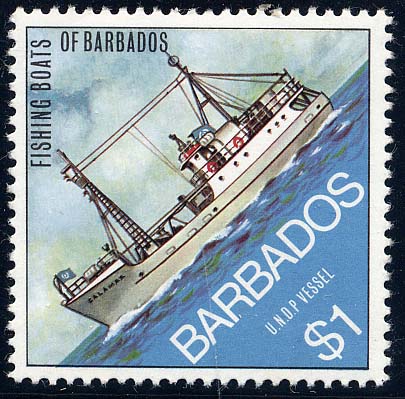
Calamar

The full index of our ship stamp archive

Calamar

Postby shipstamps » Wed Jul 09, 2008 2:57 pm


Click image to view full size
The Barbados stamp shows the CALAMAR, the first of this type of ship to appear on stamps, for she is a fishery training ship, and is owned by the Food and Agriculture Organisation of the United Nations. Her port of registry is Bridgetown, Barbados. She has a gross tonnage of 137; a net of 50 tons and summer deadweight of 64. Built in 1966 by Hayashikane Zosen, at Yokosuka, Japan, her length overall is 81 ft. 4 in; extreme breadth 22 ft. 3 in. She has a single deck and machinery aft. Her oil engine is by Caterpillar Tractor Company, Peoria, and develops 380 bhp. for a speed of 10 knots.SG483
shipstamps
Site Admin
 
Posts: 19
Joined: Fri Mar 13, 2009 8:12 pm

Return to Ship Stamps Collection

Who is online

Users browsing this forum: Google Adsense [Bot], Google [Bot] and 14 guests

Sponsored Links